
Play Tower Rush Now!
Home → Similar Games
Games Similar to Tower Rush
Games close to Tower Rush
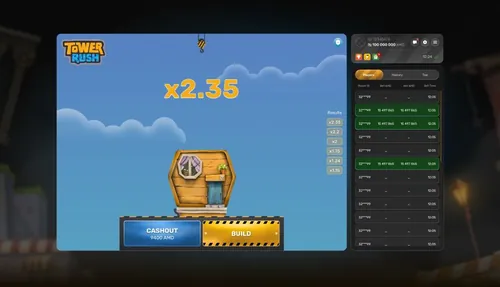
Galaxsys released Tower Rush in 2024 as a distinct crash mechanic that replaces traditional spinning reels with a rising multiplier curve. The player must cash out before the tower collapses, aiming for a maximum win of 100x on their stake. This structure creates immediate tension because the round ends instantly if the player waits too long to secure their profit.
InOut Games offers Chicken Road which provides a vastly different ceiling with a maximum win of x3,608,855 compared to the 100x cap here. Rabbit Road matches this high potential payout while maintaining a 95.50% RTP that differs from the 97.00% theoretical return found in Tower Rush. Players seeking massive multipliers will find these road-based games more suitable than the conservative crash model presented by Galaxsys.
Spribe developed Aviator which allows for a maximum win of x1,000,000, significantly exceeding the 100x limit imposed by Tower Rush. While Aviator shares the instant cash-out mechanic, its higher volatility attracts players willing to risk losing their stake for a much larger potential payout. The comparison highlights how Tower Rush remains a safer option with its lower maximum multiplier and fixed 97.00% RTP.
Titles with similar maths
The 97.00% RTP of Tower Rush matches the theoretical return of Spribe's Aviator exactly, establishing a baseline for fair play in the crash genre. Both games operate with a 3.00% house edge, meaning the casino retains three percent of all wagers over an infinite number of rounds. This mathematical identity ensures that long-term losses remain predictable for both titles despite their different visual themes and interface designs.
Chicken Road presents a 98.00% RTP which is one percentage point higher than the 97.00% return offered by Tower Rush. InOut Games achieves this slightly better player advantage through a unique probability distribution that favors smaller, more frequent wins rather than the single large cash-out opportunity. The difference between 98.00% and 97.00% represents a marginal but measurable improvement in expected value for the patient player.
Fish Road operates with a 96.00% RTP which sits below the 97.00% standard set by Tower Rush and Aviator simultaneously. InOut Games adjusts the mathematics to accommodate its specific game mechanics, resulting in a slightly higher house edge of four percent compared to the three percent in Tower Rush. This lower return figure indicates that Fish Road may drain a bankroll faster over extended sessions than the Galaxsys alternative.
Same studio alternatives
Galaxsys created Tower Rush in 2024, introducing a novel crash mechanic that diverges from the studio's previous portfolio of table games. The developer utilizes proprietary RNG technology to ensure provably fair outcomes, allowing players to verify each round's integrity via hash verification. This technical approach builds trust by making the random number generation transparent and auditable for every single bet placed on the platform.
The studio's design philosophy emphasizes simplicity and speed, evident in the straightforward interface of Tower Rush that requires no complex payline configurations. By removing traditional slot elements like reels, Galaxsys focuses entirely on the psychological thrill of timing the cash-out before the collapse. This minimalist approach reduces cognitive load and allows players to concentrate solely on reading the multiplier curve accurately.
Although Galaxsys currently lists only Tower Rush in this specific crash category, the studio's reputation for high-quality instant games suggests future releases may follow this successful formula. The 97.00% RTP demonstrates a commitment to competitive returns that aligns with industry standards for modern crash games. Players can expect consistent mathematical fairness and reliable performance from any new title launched by this established provider.
Comparable volatility
Chicken Road features medium volatility which contrasts sharply with the high-risk nature of Tower Rush where every decision carries immediate financial consequences. InOut Games balances risk and reward in Chicken Road to allow for longer gameplay sessions without the sudden total loss common in crash games. The 95.50% RTP and max win of x3,608,855 create a volatile environment that appeals to aggressive players seeking rapid bankroll growth.
Aviator exhibits variable volatility depending on when players choose to cash out, but generally aligns with the moderate risk profile of Tower Rush. Spribe's game allows for auto-cashout features that help manage risk, similar to the tools available in Tower Rush to mitigate sudden losses. The potential for a x1,000,000 win introduces extreme variance that most casual players cannot sustain, unlike the capped 100x maximum here.
Rabbit Road maintains a medium volatility setting that keeps the gaming experience accessible while still offering substantial payouts up to x3,608,855. InOut Games structures the odds to provide frequent small wins that extend playtime, differing from the all-or-nothing outcome of Tower Rush rounds. This approach suits players who prefer steady progression over the intense pressure of waiting for a multiplier to reach critical heights.
Comparable return figures
Chicken Road offers a 98.00% RTP which stands as the highest theoretical return among the comparable titles listed in this analysis. InOut Games achieves this superior percentage by adjusting the probability weights across its game rounds to favor the player slightly more than Tower Rush does. The 1.00% difference in RTP translates to a slower rate of bankroll erosion for players engaging with Chicken Road over extended periods.
Aviator matches Tower Rush at a 97.00% RTP, creating a direct equivalence in long-term expected returns between the two popular crash games. Spribe's implementation of this return rate ensures that the house edge remains constant at 3.00%, providing a familiar mathematical landscape for experienced players. This parity allows players to switch between Aviator and Tower Rush without expecting significant changes in their overall profitability or loss rates.
Fish Road drops to a 96.00% RTP, representing a 1.00% decrease from the Tower Rush return figure and a 2.00% decrease from Chicken Road. InOut Games uses this lower percentage to fund the game's unique features and higher maximum win potential of x2,542,251.93. Players prioritizing steady returns over jackpot chasing should avoid Fish Road in favor of the higher returning options available in the market.
Tower Rush compared with similar titles
| Game | Studio | RTP | Volatility | Max win |
|---|---|---|---|---|
| Tower Rush | Galaxsys | 97.00% | — | 100x |
| Chicken Road | InOut Games | 98.00% | — | x3,608,855 |
| Fish Road | InOut Games | 96.00% | — | x2,542,251.93 |
| Aviator | Spribe | 97.00% | — | x1,000,000 |
| Rabbit Road | InOut Games | 95.50% | — | x3,608,855 |
| Chicken Road 2 | InOut Games | 95.50% | medium | x3,608,855 |
| Mines | — | 97.00% | — | — |
How these titles differ
Tower Rush by Galaxsys operates as a crash game with a theoretical RTP of 97.00%, meaning players can expect a 3.00% house edge over extended play sessions. This contrasts sharply with Dice by Spribe, which allows adjustable volatility settings to change the risk profile dynamically during gameplay. The structural difference dictates that Tower Rush requires precise timing for cashing out before the multiplier collapses, whereas Dice relies on binary outcome probabilities.
The Tower-building mechanic in Galaxsys's release involves stacking floors where each success multiplies cumulative odds until collapse, unlike Chicken Dash by TaDa Gaming which features high volatility and a max win of 20,659x. This linear progression in Tower Rush caps at 100x, offering more frequent but smaller payouts compared to the explosive potential found in other instant games. Players must manage their bankroll carefully because the maximum multiplier is significantly lower than what high-volatility titles typically offer to casual users.
Provably fair technology via hash verification ensures transparency in Galaxsys's Tower Rush, a feature also present in some other crypto-friendly platforms but absent in traditional slots. Unlike Mines which lacks a published studio name, Tower Rush provides clear developer attribution and standardized rules for every round played on mobile devices. This clarity helps players understand exactly how the random number generator functions without needing complex third-party audits or external verification tools.
Feature sets side by side
The Triple Build bonus floor in Galaxsys's Tower Rush increases potential returns by allowing multiple simultaneous bets within a single round structure, enhancing strategic depth. This differs from Plane Game by Spribe, which maintains high volatility without such interactive building mechanics, relying solely on passenger survival for wins. The auto cashout feature in Tower Rush allows players to set predefined thresholds, ensuring profits are secured even if the tower collapses unexpectedly during rapid play.
Frozen Floor mechanics in Tower Rush pause certain collapse risks temporarily, providing a unique advantage not found in Plinko which uses static peg distributions for outcomes. Temple Floor adds another layer of complexity by modifying multiplier values based on previous rounds, creating a dynamic environment distinct from the fixed odds of Dice. These special floors require players to adapt their betting strategies frequently, unlike simpler games where the payout structure remains constant throughout the session.
RTP variations between 96.2% and 97.6% depending on operator configuration mean players might encounter different return rates when switching between casinos hosting Galaxsys titles. This variability contrasts with Spribe's Dice which consistently offers a 97.00% RTP across all configurations, providing predictable long-term expectations for analytical players. Understanding these differences helps mobile users choose platforms that align with their preferred risk tolerance and desired theoretical return percentages.
Payout ceilings compared
Galaxsys's Tower Rush limits maximum wins to 100x the initial stake, capping potential earnings regardless of how many floors are successfully stacked during a round. This ceiling is significantly lower than Chicken Dash by TaDa Gaming, which offers a massive max win of 20,659x for high-risk players seeking life-changing payouts. The conservative cap in Tower Rush ensures more frequent small wins, appealing to players who prefer steady growth over rare jackpot opportunities on mobile screens.
Dice by Spribe provides a max win of x970, bridging the gap between modest returns and high-stakes potential found in other instant games available online. While this exceeds Tower Rush's 100x limit, it falls far short of the extreme multipliers offered by high-volatility titles like Chicken Dash. Players should consider their risk appetite when choosing between these options, as higher ceilings often come with increased likelihood of total loss during volatile sessions.
Plane Game by Spribe shares the 97.00% RTP with Dice but does not specify a hard cap on multipliers, implying potentially higher unbounded returns under ideal conditions. In contrast, Tower Rush enforces a strict 100x maximum multiplier, providing clear boundaries for bankroll management and preventing unexpected large losses from chasing unrealistic heights. This defined limit helps players maintain control over their spending habits while enjoying the fast-paced nature of crash-style gaming on mobile devices.
Bet ranges compared
Welcome bonuses often include free spins alongside deposit matches, such as a 300% match up to €2,000 plus 100 free spins offered by many operators for new accounts. These incentives typically apply to slot games rather than crash titles like Tower Rush, requiring players to use separate funds for instant game wagering. Mobile users must navigate these restrictions carefully to avoid violating terms when attempting to utilize bonus credits on provably fair crash mechanics.
Wagering requirements for bonus funds usually demand significant turnover before withdrawal eligibility, calculated as deposit plus bonus multiplied by the wagering factor, e.g., 100 € + 300 % = 400 €; 400 € x 40 = 16,000 € turnover. Such high turnover targets are rarely achievable through low-limit crash games like Tower Rush due to the speed of rounds and limited bet sizes per second. Players should assess whether their preferred instant game strategy aligns with these stringent promotional conditions before committing real money to platform accounts.
Minimum bets in Tower Rush vary by operator but generally start around 0.10 €, allowing micro-staking strategies suitable for testing provably fair algorithms safely. This low entry point contrasts with high-volatility slots where minimum bets might be higher due to reel spin costs and payline requirements. Mobile players benefit from this flexibility, enabling them to extend gameplay duration and gather sufficient data points for statistical analysis without risking substantial capital initially.
Which suits which player
Analytical players preferring mathematical precision will appreciate Tower Rush's transparent RTP of 97.00% and provably fair hash verification provided by Galaxsys. This appeals to those who enjoy calculating expected value over thousands of rounds, similar to how they would approach Dice by Spribe with its adjustable volatility settings. The structured floor-building mechanic offers a logical progression that rewards careful planning rather than luck alone, satisfying methodical gamblers on mobile platforms.
Risk-averse individuals may find Tower Rush's 100x max win cap comforting compared to the unlimited potential of Plane Game by Spribe or Chicken Dash by TaDa Gaming. The ability to cash out anytime reduces exposure to sudden losses, making it suitable for players who prioritize capital preservation over chasing huge multipliers. This cautious approach aligns well with the game's design, which emphasizes steady accumulation of small wins rather than dramatic swings typical of high-variance titles.
Social gamers might enjoy the communal aspect of watching towers collapse in real-time, though Tower Rush lacks direct multiplayer interaction found in some live dealer variants. Instead, players compete indirectly against the algorithm's randomness, focusing on personal bests and streaks rather than head-to-head competition. This solitary yet engaging experience suits mobile users seeking quick, intense bursts of activity without the commitment required for longer session-based casino games.
Trying alternatives in demo
Tower Rush, released by Galaxsys in 2024, offers a theoretical return of 97.00% over extended play sessions. This figure represents the house edge of 3.00%, which is higher than Spaceman's 96.50% RTP from Pragmatic Play. Consequently, players should expect slightly lower long-term returns compared to alternative crash games.
The maximum win cap in Tower Rush stands at 100x the stake, whereas Spaceman allows payouts up to 5000x the bet amount. This significant difference limits the potential upside for high-risk strategies in the instant game format. Players seeking larger multipliers might find the lower cap restrictive during volatile rounds.
Demo modes allow users to test the triple build bonus floor without risking real currency on the RNG-based mechanic. While the base game mechanics remain identical, the free-play version lacks the provably fair hash verification used in live sessions. This distinction ensures that actual financial outcomes rely on verified cryptographic security rather than simulated randomness.
Why variety helps bankroll
Comparing Tower Rush with Fortune Rabbit reveals distinct volatility profiles despite both offering 5000x max wins in their respective categories. Fortune Rabbit operates on a non-standard 3-4-3 row grid with medium volatility, contrasting sharply with the linear multiplier climb of the crash genre. Diversifying across these genres prevents rapid depletion of funds during high-variance streaks.
The 300% welcome bonus up to €2,000 plus 100 free spins provides substantial initial capital for testing multiple titles. Allocating portions of this bonus to different studios like Galaxsys and PG Soft spreads the risk across varying game mechanics. This strategy mitigates the impact of losing streaks inherent in any single title's random number generator.
Spaceman's high volatility requires larger buffer reserves than the more predictable payout structure of Tower Rush's frozen floor feature. Managing stakes relative to each game's specific risk profile ensures sustainable play across diverse portfolios. Players can adjust bet sizes dynamically based on the immediate volatility characteristics of the active session.
Studios worth knowing
Galaxsys developed Tower Rush, introducing a unique tower-building mechanic where players stack floors to increase cumulative odds. The studio implements three special bonus floor types: Frozen Floor, Temple Floor, and Triple Build, each altering the crash probability. Understanding these specific mechanics is crucial for optimizing cash-out timing within the rising multiplier curve.
Pragmatic Play created Spaceman, a game characterized by high volatility and a maximum win potential of 5000x the wager. The provider's approach focuses on fast-paced action with simpler rules compared to the complex floor-stacking of Tower Rush. Comparing Galaxsys's detailed bonus features against Pragmatic Play's streamlined design highlights different strategic approaches to crash gaming.
PG Soft, also known as Pocket Games Soft, produced Fortune Rabbit, which utilizes a non-standard 3-4-3 row grid layout. This structural difference contrasts with the linear progression of Tower Rush, offering a visually distinct gameplay experience alongside medium volatility. Recognizing these developer-specific traits helps players select titles that align with their preferred risk and engagement levels.
Newer releases in the genre
Tower Rush, launched in 2024 by Galaxsys, introduces a fresh take on the crash genre with its tower-stacking premise. The game's 97.00% RTP sets it apart from older titles that may offer lower theoretical returns due to higher house edges. Recent releases often prioritize provably fair technology, enhancing transparency through hash verification for every round played.
While newer titles focus on innovative mechanics, established games like Spaceman maintain popularity through consistent high-volatility performance. Spaceman's 5000x max win cap remains a benchmark for potential payouts in the current market landscape. Newer entrants must balance novelty with competitive RTP figures to attract players accustomed to proven standards.
The integration of auto-cashout features in Tower Rush reflects modern player demands for automated risk management tools. This function allows setting predefined thresholds before the multiplier rises, reducing emotional decision-making during rapid rounds. Such technological advancements distinguish contemporary releases from earlier, manually driven versions of similar games.
Picking your next title
Players seeking higher maximum wins might prefer Spaceman's 5000x cap over Tower Rush's 100x limit, accepting higher volatility for greater rewards. Spaceman's 96.50% RTP also offers a slightly better theoretical return than Tower Rush's 97.00% when adjusted for risk tolerance. This choice depends on whether the player prioritizes frequent smaller gains or rare large payouts.
For those interested in structured bonus mechanics, Tower Rush's triple build and temple floor features provide varied strategic options. These elements add complexity absent in simpler crash games, appealing to players who enjoy analyzing floor probabilities. The provably fair system further supports informed decision-making by allowing post-round verification of results.
Fortune Rabbit offers an alternative with medium volatility and a 5000x max win, bridging the gap between high-risk crash games and stable slots. Its 3-4-3 grid layout presents a different visual and mechanical challenge compared to the linear ascent of Tower Rush. Selecting between these titles requires evaluating personal preference for grid-based versus multiplier-based progression systems.
DemoRTP & VolatilityHow to PlayAuto CashoutStrategyBonusesMobileDownload & AppMax WinSimilar GamesReviewFAQSitemap
Tower Rush 2026